Director
Alan Stewart (Columbia University)
Alan Stewart is Professor of English and Comparative Literature at Columbia University, which he joined in 2003 after teaching for ten years at Queen Mary and Birkbeck in the University of London. His publications include Close Readers: Humanism and Sodomy in Early Modern England (1997); Hostage to Fortune: The Troubled Life of Francis Bacon 1561-1626 (with Lisa Jardine, 1998); Philip Sidney: A Double Life (2000); The Cradle King: A Life of James VI and I (2003); Letterwriting in Renaissance England (with Heather Wolfe, 2004); Shakespeare’s Letters (2008); and The Oxford History of Life-Writing, vol. 2, Early Modern (2018). He co-edited the three-volume Wiley-Blackwell Encyclopdia of English Renaissance Literature (with Garrett Sullivan, 2012), and edited the Broadview Anthology of Tudor Drama (2021). With Lisa Jardine, he founded the AHRC Centre for Editing Lives and Letters in 2002. He has won awards from the British Academy, the Arts and Humanities Research Board, and the Folger Shakespeare Library, and in 2011-2012 he was a John Simon Guggenheim Fellow. Alan Stewart joined the Oxford Francis Bacon project as an MHRA Research Associate in 1992. With Harriet Knight, he edited volume I, Early Writings 1584-1596 (2012) and is now editing volume II, Late Elizabethan Writings 1596-1602.
Editorial Team
Daniel C. Andersson (Wolfson College, Oxford)
Daniel C. Andersson gained his PhD at the Warburg Institute, and held a Research Fellowship at Wolfson College, Oxford. He is a scholar of the cultural, intellectual, religious and literary life of early modern Europe, working chiefly on Francis Bacon, Philology, Aristotelianism and Calvinism. Recently, he has examined Calvinist notions of the care of the soul in Ames, Perkins and Abernethy, as well as the Habsburg reception, above all in Hungarran, of these authors. These are the chief strands of his current interests in early modern history, with philology, exchange, Calvin, Aristotle being the chief tufts in the ‘thought-cloud’.
David Colclough (Queen Mary, University of London)
David Colclough is Professor of Renaissance Studies at Queen Mary University of London. His edition of New Atlantis was published in 2025 as vol. XIX of the Oxford Francis Bacon. Beyond Bacon, his current research primarily focuses on John Donne, whose Sermons at the Court of Charles I he edited as volume 3 of The Oxford Edition of the Sermons of John Donne (OUP, 2013); he is now preparing volume 14 (Sermons Preached at St Paul’s Cathedral, 1628-1630). He is the author of the ODNB life of Donne, and the editor of John Donne’s Professional Lives (D.S. Brewer, 2003). His monograph Freedom of Speech in Early Stuart England was published by CP in 2005.
David Foster (University College London)
David Foster is an Associate Professor in Law at University College London. He is an expert in English legal history, with a particular specialism in records and manuscripts relating to the Court of Chancery in the seventeenth century. He has published widely on the history of Chancery and equity, including a recent edited collection (Essays on the History of Equity, Hart Publishing, 2026).
Leofranc Holford-Strevens (Oxford University Press, retired)
Until his retirement in 2011, Dr Leofranc Holford-Strevens was Consultant Scholar-Editor at the Oxford University Press. He is a classical scholar with wide interests in other fields, principally languages, literature, history, chronology, and musicology. His publications include: Aulus Gellius (London, 1988), revised as Aulus Gellius: An Antonine Scholar and His Achievement (Oxford, 2003; corrected paperback 2005); (with Bonnie J. Blackburn) The Oxford Companion to the Year (Oxford, 1999); (edited with Amiel D. Vardi), The Worlds of Aulus Gellius (Oxford, 2004); The History of Time: A Very Short Introduction (Oxford, 2005); (with Bonnie J. Blackburn), Florentius de Faxolis: Book of Music (Cambridge, MA, 2010).
Dana Jalobeanu (University of Bucharest/University of Technology, Nuremberg)
Dana Jalobeanu is Professor of Philosophy at the University of Bucharest, and since 2025 Professor of Early Modern Philosophy at the University of Technology, Nuremberg. Trained in theoretical physics and philosophy, she has a PhD in Epistemology and Philosophy of Science from the University of Bucharest (2000), and Habilitation in Philosophy (History and Philosophy of Science) at the same university. Jalobenau is the co-founder of the Princeton-Bucharest Seminar in Early Modern Philosophy, co-editor of the Journal of Early Modern Studies, and president of the European Society for History of Science (since 2020). In addition to many articles, she is author of The Art of Experimental Natural History: Francis Bacon in Context (Zeta Books, 2015) and Spectacolul filosofiei. Cum să citim Scrisorile lui Seneca (The Theatre of Philosophy: How to read Seneca’s Letters (Humanitas, 2022), and co-editor of Francis Bacon on motion and power (Springer, 2016), Cambridge History of Philosophy of the Scientific Revolution (Cambridge UP, 2022), and Encyclopedia of Early Modern Philosophy and the Sciences (Springer, 2022). She is translating and editing the works of Francis Bacon for the Romanian edition (Humanitas, 2011, 2013, 2022) and editing vol. XIX, Sylva sylvarum, for the Oxford Francis Bacon.
Michael Kiernan (Pennsylvania State, emeritus)
Michael Kiernan received his doctorate from Harvard University where he was Resident Tutor at Mather House. An Associate Professor of English Emeritus at Penn State University (University Park), he has taught Shakespeare and Renaissance/early modern literature. Professor Kiernan has edited three volumes for the Oxford Francis Bacon. His 1985 edition of The essayes or counsels, civill and morall, jointly published by Harvard University Press and Oxford University Press, was adopted in 2000 as vol. XV of the OFB. In 2000, he published volume IV, The advancement of learning. His edition of The Historie of the raigne of King Henry the seventh and other works of the 1620s (vol. VIII) was published in 2012. Research for these volumes was supported by grants from the American Philosophical Society, the American Council of Learned Societies, the Folger Shakespeare Library, the Henry E. Huntington Library, the British Academy, and Penn State.
James A. T. Lancaster (University of Queensland)
Dr Lancaster is an intellectual historian who received his PhD from the Warburg Institute, University of London. He is presently Lecturer in Studies in Western Religious Traditions in the School of Historical and Philosophical Inquiry at The University of Queensland. As a member of the Editorial Board of the Oxford Francis Bacon critical edition, he has published on the philosophical and religious thought of Francis Bacon. His publications include: ‘Natural Knowledge as a Propaedeutic to Self-Betterment: Francis Bacon and the Transformation of Natural History’ in Early Science and Medicine; ‘Natural Histories of Religion: A (Baconian) “Science”?’ in Perspectives on Science; and a chapter, ‘Francis Bacon on the Moral and Political Character of the Universe’, in his co-edited volume with Guido Giglioni et al., Francis Bacon on Motion and Power (2016).
Rhodri Lewis (Princeton University)
After spending 23 years at the University of Oxford, Rhodri Lewis moved permanently to Princeton in 2018. His interests lie principally in the literary, cultural, and intellectual histories of the long sixteenth and seventeenth centuries, but he has published on authors and topics ranging from classical antiquity to the present day. His books include: Language, Mind and Nature: Artificial Languages in England from Bacon to Locke (Cambridge UP, 2007); William Petty on the Order of Nature: An Unpublished Manuscript Treatise (Medieval and Renaissance Texts and Studies, 2012); (Princeton UP, 2017); and (Princeton UP, 2024). At present, he is at work on a life of the great literary critic Frank Kermode. Once this is finished, he will be returning to early modernity — to an edition of Francis Bacon’s De sapientia veterum (Wisdom of the Ancients) for OFB, vol. V, and to King Lear. His research has been supported by grants and fellowships from institutions including the Leverhulme Trust, the Mellon Foundation, the British Academy, the Huntington Library, and the Institute for Advanced Study in Princeton, and he was a 2025-26 Guggenheim Fellow.
Richard Serjeantson (Trinity College, Cambridge)
Richard Serjeantson is editing Volume III and VI of the OFB in collaboration with Angus Vine. He has published a number of studies of Bacon’s life and writings arising broadly from this work, including (with Thomas Woolford) ‘The Scribal Publication of a Printed Book’, The Library, 7th ser., 10 (2009) 119-56 and ‘Francis Bacon and the Late Renaissance Politics of Learning’, in For the Sake of Learning, ed. Ann Blair and Anja Goeing (Brill, 2016), pp. 195–211. His edition of Valerius Terminus of the Interpretation of Nature will appear in Volume V of the OFB; a preparatory study of that work appeared as ‘Francis Bacon’s Valerius Terminus and the Voyage to the “Great Instauration”’, JHI, 78 (2017), 341–68. With Michael Edwards he has also published an edition of what is now the earliest known treatise by a different early modern philosopher: René Descartes, Regulae ad directionem ingenii: An Early Manuscript Version (Oxford UP, 2023).
Angus Vine, FSA, FRHistS (University of Stirling)
Angus Vine is editing Volumes III and VI of the OFB in collaboration with Richard Serjeantson. He has published a number of studies of Bacon’s life and writings arising broadly from this work, including ‘Francis Bacon’s Composition Books’, Transactions of the Cambridge Bibliographical Society, 14 (2008), 1-33; ‘A New Version of Bacon’s Apologie: MS Rawlinson D. 672′, Bodleian Library Record, 21 (2008), 118-37; ‘Commercial Commonplacing: Francis Bacon, the Waste-Book, and the Ledger’, English Manuscript Studies, 1100-1700,16 (2011), 197-218; and ‘”His Lordships First, and Last, Chapleine”: William Rawley and Francis Bacon’, in Chaplains in Early Modern England, eds Hugh Adlington, Tom Lockwood and Gillian Wright (Manchester UP, 2013), pp. 123–140.
Maria Wakely (Queen Mary University of London, retired)
Maria Wakely worked with Graham Rees on four volumes of the Oxford Francis Bacon (VI, XI, XII, XIII), and established texts for use on vols. IX, X, XVIII and XIX. She is also the co-author, with Rees, of Publishing, politics, and culture: the king’s printers in the reign of James I and VI (Oxford UP, 2009).
Sophie Weeks (University of York)
Sophie Weeks’s research focuses on Francis Bacon. She is currently working on two projects: first, she is completing a book entitled Francis Bacon’s Science of Magic. Offering a novel interpretation of the knowledge-power relationship in Francis Bacon’s ‘Great Instauration’, this study argues that Bacon proposed a science of magic as the very core of his whole programme for the reform of natural knowledge. Sharing certain goals with the occult sciences, Bacon’s project intended the production of novelties and wonders beyond our wildest expectations and dreams. Indeed, there is something appalling, Faustian even, in Bacon’s ambition to conquer nature, including human nature. However, while sharing the goals of the occult sciences and approving their experiential or experimental bias, he scorns the theoretical underpinnings they offer and their lack of methodical perseverance. In fact, Bacon’s science of magic is resolutely anti-occultist. Second, she is editing (with Daniel Andersson, Rhodri Lewis, and Richard Serjeantson) Volume V of the Oxford edition of Francis Bacon’s works, which comprises Bacon’s early philosophical writings to about 1611.
Ian Williams (St John’s College, Oxford)
Dr Ian Williams (Associate Professor in Law, St John’s College, Oxford) is a specialist in early modern English legal history and the editor of the Journal of Legal History. He often works on placing legal history into a wider context, and his scholarship ranges widely within legal history. Dr Williams has recently completed a large piece of editorial work, a parallel-text edition of Star Chamber law reports in their original law-French and the early modern translation, to be published by the Selden Society as their 2026 volume.
Samuel Garrett Zeitlin (University College London)
Samuel Garrett Zeitlin is University Lecturer in Modern Intellectual History at University College London. He gained his PhD, on ‘War and Peace in the Political Thought of Francis Bacon’, from the UNiversity of California-Berkeley in 2018. He has published on Bacon’s political thought and writings on war and empire in History of Political Thought, History of European Ideas, The Review of Politics, Political Research Quarterly and Global Intellectual History, as well as in the recent volume, Reframing Treaties in the Late Medieval and Early Modern West (Oxford, 2025). Dr |Zeitlin has also done editorial and translation work on the political thought of Raymond Aron for the volume Liberty and Equality (Princeton, 2023) and on Carl Schmitt, most recently in Schmitt’s Early Legal-Theoretical Writings (Cambridge, 2021) and Schmitt’s history of the First World War, State Composition and Collapse (Polity, 2025).
Advisory Board
Peter Beal (Sotheby’s/Institute of English Studies, University of London, retired)
Peter Beal, FBA, was for 25 years the English manuscripts expert (for nine of them a Director) at Sotheby’s, London. He was elected a Fellow of the British Academy in 1993; was J.P.R. Lyell Reader in Bibliography at Oxford, 1995–96; and in 2002 was appointed Senior Research Fellow at the Institute of English Studies, University of London. His major publications in the field of early modern manuscripts include Index of English Literary Manuscripts, 1450–1700 (4 vols, Mansell, 1980–93), In Praise of Scribes: Manuscripts and their Makers in Seventeenth-Century England (OUP, 1998), and A Dictionary of English Manuscript Terminology (OUP, 2008). He also co-founded and co-edited the near-annual series of volumes English Manuscript Studies 1100–1700 (1989- ). From 2005 to 2013, he was principal researcher on CELM (Catalogue of English Literary Manuscripts), an online adaptation and extension of the Index of English Literary Manuscripts.
J. W. Binns, FBA (University of York, emeritus)
J. W. Binns was formerly Reader in Latin Literature at the University of York. He is the author of Intellectual Culture in Elizabethan and Jacobean England. The Latin Writers of the Age (Leeds, 1990) and the editor, with Shelagh Banks, of Gervase of Tilbury, Otia imperialia. Recreation for an Emperor (Oxford, 2002). He was elected to the British Academy in 2004, and is currently a General Editor of Oxford Medieval Texts.
Mordechai Feingold (California Institute of Technology)
Mordechai Feingold is an intellectual and institutional historian of science, from the Renaissance to the eighteenth century. His research focuses on how the rise of modern science has transformed Western culture from a humanistic, religious, and unified culture during the sixteenth century into a scientific, technological, secular, and fragmented one by the nineteenth century.
Daniel Garber (Princeton University)
Ph.D. Harvard, 1975. Garber joined the Philosophy Department faculty at Princeton in 2002. He is also an Associate Member of both the Program in History of Science and the Politics Department. Garber’s principal interests are the relations between philosophy, science, and society in the period of the Scientific Revolution. Garber is the author of Descartes’ Metaphysical Physics (1992) and Descartes Embodied (2001), and is co-editor with Michael Ayers of the Cambridge History of Seventeenth-Century Philosophy (1998). Most recently he published Leibniz: Body, Substance, Monad (2009). Garber is also the co-editor with Donald Rutherford of the Oxford Studies in Early Modern Philosophy, an annual. He is currently working on a variety of topics, including studies of Aristotelianism and its opponents in early seventeenth-century France. In addition, he is the editor-in-chief of a new edition of the works of the seminal seventheenth-century thinker, Jacobus Fontialis.
Jill Kraye (Emeritus Professor, Warburg Institute)
B.A. in History (Departmental Honors with Great Distinction and University Honors with Great Distinction): University of California at Berkeley, 1969. M.A. in History: Columbia University, 1970. Ph.D in History (with distinction): Columbia University, 1991. Main research and supervision interests are: Renaissance humanism and philosophy, the later influence of classical philosophy (Aristotelianism, Platonism, Epicureanism and Stoicism), and European intellectual history, 1350-1650.
Markku Peltonen (University of Helsinki)
Markku Peltonen is a historian at the University of Helsinki whose writings focus on early modern England. He is author of multiple monographs, including Classical humanism and republicanism in English political thought 1570-1640 (Cambridge, 1995), The Duel in Early Modern England: Civility, Politeness and Honour (2006), and The Political Thought of the English Free State, 1649–1653 (Cambridge, 2022). Professor Peltonen also edited the Cambridge Companion to Bacon (1996).
Claire Preston (Queen Mary, University of London)
I joined Queen Mary in September 2013 after spending much of my career at Cambridge. I have also held posts at Oxford and Birmingham. My doctoral research considered word and image relationships in Sidney and Shakespeare; my subsequent research on Renaissance literature has been supported by awards from the British Academy and the Guggenheim Foundation, and I currently hold a major AHRC grant supporting the OUP’s Complete Works of Sir Thomas Browne (forthcoming from Oxford, 2015-2019), of which I am the general editor. My books include monographs on Edith Wharton (2000), Sir Thomas Browne (2005), the cultural history of bees (2006), and the poetics of seventeenth-century science (2015). My recent television and radio work includes The Century that Wrote Itself (with Adam Nicolson); For the Love of Honey (with Martha Kearney); and interviews on BBC Radio 3, National Public Radio (USA) and the Australian Broadcasting Corporation. I was awarded the British Academy’s Rose Mary Crawshay Prize in 2005 and the British Society for Literature and Science Prize in 2015.
Heather Wolfe (Folger Shakespeare Library)
Heather Wolfe is Curator of Manuscripts and Associate Librarian at the Folger Shakespeare Library. Her first book, Elizabeth Cary, Lady Falkland: Life and Letters (2000) received the first annual Josephine Roberts Scholarly Edition Award from the Society for the Study of Early Modern Women. She has written widely on the intersections between manuscript and print culture in early modern England, and edited The Trevelyon Miscellany of 1608 (2007), The Literary Career and Legacy of Elizabeth Cary (2007), and Letterwriting in Renaissance England (2004) (with Alan Stewart). Her essay “The Material Culture of Record-Keeping in Early Modern England,” co-written with Peter Stallybrass, received the 2019 Archival History Article Award from the Society of American Archivists. She is currently working on a book on writing paper in early modern England. She received her BA from Amherst College, her M.L.I.S. from UCLA, and her Ph.D. from the University of Cambridge.
Past General Editors and Directors
Graham Rees †
The Oxford Francis Bacon critical edition was originally the brainchild of the late Professor Graham Rees (1944-2009), who was responsible for overseeing the publication of the first six volumes. Professor Rees was responsible for editing The Oxford Francis Bacon VI: Philosophical Studies c.1611–c.1619, The Oxford Francis Bacon XI: The Instauratio magna, Part II: Novum organum, The Oxford Francis Bacon XIII: Instauratio magna: Last Writings and, with Maria Wakely, The Oxford Francis Bacon XIII: Instauratio magna, Part III: Historia naturalis and Historia vitae.
Brian Vickers (Institute of English Studies, University of London)
Born 13 December 1937 in Cardiff, Great Britain. I was educated at St. Marylebone Grammar School, London, and Trinity College, Cambridge, where I took a double first in English and won both the Charles Oldham Shakespeare Scholarship and the Harness Prize. I was a Fellow and Director of Studies at Downing College and a University Lecturer in English. In 1972 I was appointed Professor (Ordinarius) at the University of Zürich, and in 1975 I moved to the Eidgenössische Technische Hochschule, where I also directed the Centre for Renaissance Studies. Subsequent to my retirement in 2003 I became a Distinguished Senior Fellow at the School of Advanced Study, University of London. I am a Fellow of the British Academy, an Honorary Foreign Member of the American Academy of Arts and Sciences, an Honorary Fellow of Downing College, Cambridge, and an Honorary Visiting Professor at University College, London. In 2008 I was knighted for services to literary history. I was awarded the Ph. D. and D. Litt. by Cambridge, an Honorary D. Lit. by London University, and an Honorary Ph. D. by the University of Fribourg, Switzerland.
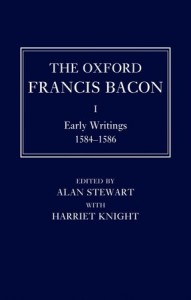 The Oxford Francis Bacon I: Early Writings 1584-1596, ed. by Alan Stewart with Harriet Knight (Oxford University Press, 2012), pp. 1,136. ISBN: 978-0-19-818313-6.